

 LinkedIn
The gap is a missing answer, not a missing page
When ChatGPT skips your company, the problem may be a single unanswered sub-question buried inside a buyer’s prompt. Write another 3,000-word guide without finding that question, and you can make the page longer without making it easier to cite.
I spent years watching search marketers buy content-gap audits that delivered the same thing: a spreadsheet of terms competitors ranked for and the client did not. Now some AI visibility tools put a new label on that spreadsheet. The implied fix is familiar too: publish a page targeting each missing topic.
But an AI citation gap is often a passage gap. A generative search engine can break a prompt into narrower lookups, retrieve candidate pages, and use selected passages to build an answer. If no passage on your site resolves one of those lookups cleanly, owning a comprehensive page on the general topic may not help. Ten Point Labs’ analysis of generative search gaps makes the distinction between tracking prompt-level mentions and examining the text that could actually support an answer.
That is the model I use here: start with the buyer’s question, follow the narrower questions it creates, then inspect the passages available to answer them. Each step gives us a more useful definition of a gap.
Step 1: a buyer’s prompt creates smaller questions
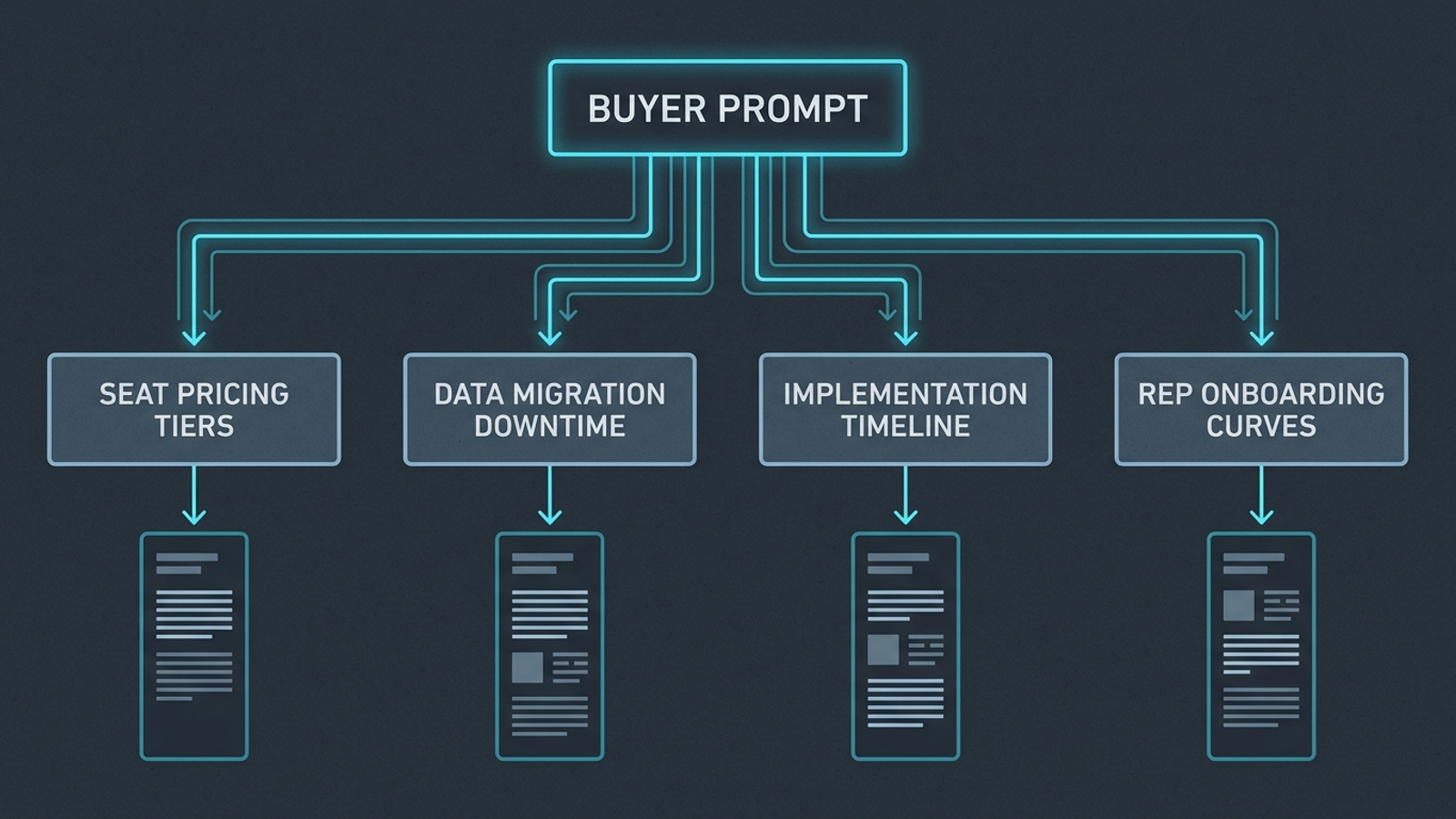
Take a VP of Sales asking: “Which CRM is best for a 20-person sales team migrating from spreadsheets?” A useful answer has to do more than name a CRM. It may need to address cost for 20 seats, whether spreadsheet contacts can move over, how long setup takes, and what onboarding looks like for the team.
This is the principle behind query fan-out. As Similarweb explains in its discussion of generative search, an engine can pursue several related searches rather than rely on the buyer’s original wording alone. Profound’s discussion of AI search retrieval strategies describes the same practical challenge for publishers: the answer may depend on narrower information needs than the headline prompt reveals. For our CRM buyer, plausible lookups include:
CRM seat pricing tiers 20 users monthly costCRM spreadsheet CSV contact migration downtimeSales pipeline software implementation timeline small teamHubSpot vs Pipedrive user onboarding 20 reps
Those are illustrative sub-queries, not a transcript of an engine’s private search process. Their value is diagnostic. They force us to ask what the buyer needs resolved before any recommendation sounds credible.
A 4,000-word article titled “The Ultimate Guide to CRM Software in 2026” might cover the category thoroughly and still fail this test. If it spends its first 1,500 words defining customer relationship management, it offers little help with a seat-pricing question. If it mentions spreadsheet migration only in a broad paragraph about change management, it leaves the buyer’s operational question open.
That does not mean broad guides are worthless. It means topic coverage and answer coverage are different things. As I explain in what happens between a buyer’s prompt and a citation, a page has to be useful at the point where the engine looks for an answer, not merely relevant to the prompt as a whole. For this buyer, list the narrower questions before commissioning another CRM guide.
Step 2: the engine may use a passage, not your whole guide
Once the engine has questions to resolve, it needs source material. TryRankly’s breakdown of ChatGPT Search describes a pipeline that includes retrieving candidate pages and selecting material for an answer. The distinction that matters to an editor is simple: being retrieved as a URL does not guarantee that any particular paragraph will be used.
Systems that retrieve passages often divide long documents into smaller text windows. Presenc AI’s explanation of passage retrieval describes how chunks let a system search within documents instead of treating every page as one indivisible unit. Exact boundaries and selection methods vary, but the editorial consequence is plain. A 3,000-word guide can contain several potential answers, and each one must make sense when encountered without the rest of the guide.
Return to the CRM article. Suppose a paragraph says, “The platform typically takes between 3 and 5 business days to migrate.” The product name appears two headings earlier. A reader moving through the page may know what “the platform” means. A retrieved passage containing only that paragraph may not tell an answer generator which product the timeline belongs to.
A competitor’s shorter documentation page could do the job better if one passage connects the product name, the migration task, and the timeframe. Its brevity is not magic. Its answer survives separation from the surrounding page.
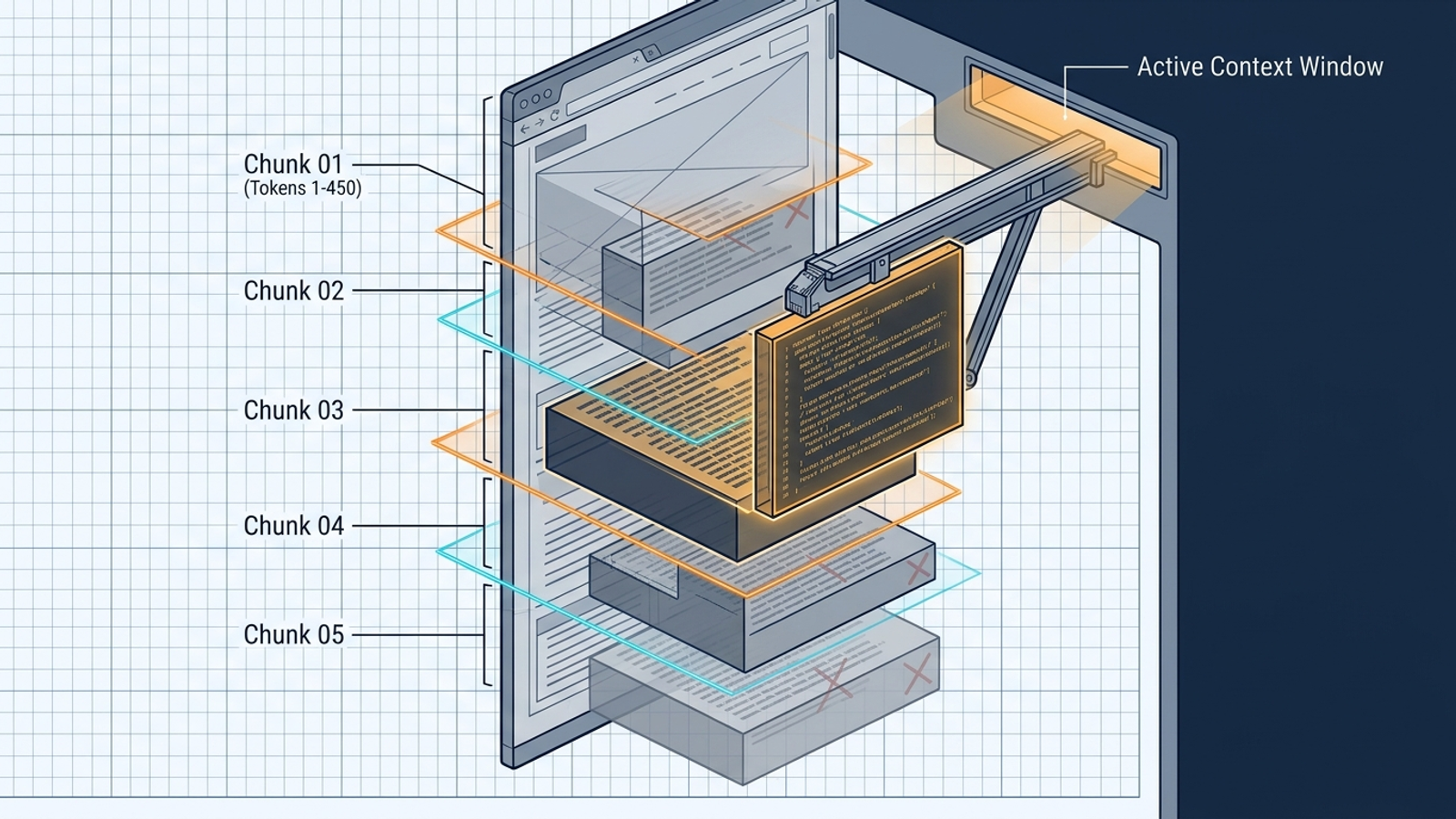
Here is where the analogy to traditional page optimization breaks. A page can build an argument gradually for a human reader; a passage selected for one narrow question cannot rely on every earlier section coming along for the ride. I would still write for the human. I would also make sure the sentence carrying the answer names what it is answering. Read each important passage on its own before you publish it.
Step 3: make the answer easy to use
The next layer is not about sprinkling a keyword into every paragraph. It is about giving the answer generator a passage that resolves a specific question without requiring it to guess.
The summary of the Princeton GEO benchmark study reports that adding verifiable statistics improved visibility in the study, while keyword stuffing performed worse. That is a useful direction, not a license to manufacture numbers. The point is that specific, supportable information gives a passage something to contribute.
Compare two openings to a section about CRM migration. The first says, “Selecting a sales CRM requires balancing multiple priorities, and the right choice depends on your team’s culture.” Fair enough. It does not answer what the buyer asked about moving a 20-person team off spreadsheets.
The second opening would name the product, state whether it supports the relevant migration route, and specify the constraint the buyer needs to check. I am not filling in those product facts here; they belong to the company that can verify them. The difference is structural: the second passage gives a reader, and an engine, an answer to work with.
Ziptie’s analysis of AI search source selection reports that 44% of the ChatGPT citations it examined came from the top third of a webpage. That finding supports a practical editing habit: put the useful answer near the question instead of making the reader cross four introductory paragraphs to find it. For a section meant to resolve a buyer’s sub-question, I look for three elements:
- An answer first: name the product or subject and state the relevant conclusion.
- The operating constraint next: give the price, limit, timeline, or condition if you can substantiate it.
- The basis for the claim: point to the documentation, pricing information, or evidence already behind that answer.
This is not a rule that every answer needs three sentences or a number. Some questions need a careful qualification. But “it depends” should lead to what it depends on, not replace the answer. For the CRM page, check whether the migration section can tell a buyer what to verify before moving 20 people. If it cannot, clearer prose alone will not fix it.
Step 4: understand why a thinner page can win
This is the citation outcome that annoys people: your company publishes the exhaustive guide, while a competitor gets cited for a short FAQ. I understand the irritation. I also know how easily a long guide can make its best answer hard to find.
An answer generator has limited room for source material. A concise FAQ that names the product, states the relevant condition, and stays on the buyer’s question is easier to use than a sprawling section that circles the point. The FAQ did not necessarily win because it was short. It won the particular job of answering that particular question.
That distinction matters because it changes the assignment. Cutting every article to 350 words would throw away useful context. Adding a clearly titled, self-contained answer to the existing guide may be enough. In our CRM example, keep the broader comparison if it helps a buyer decide. Give the spreadsheet-migration question a passage that does not require the buyer, or the engine, to reconstruct an answer from three distant sections.
Where the gap actually happens
When a paid-search campaign burns budget without producing qualified pipeline, I do not diagnose it from an annual revenue chart. I look for the point of failure: the search term, the targeting, the tracking, or the landing page. Citation gaps deserve the same discipline. For the CRM prompt, I would check three distinct failure points, in order:
- No answer exists. The site covers CRM features but never addresses, say, the seat minimum for a permission setting or the route from spreadsheet contacts into the product. The gap is the buyer’s operational constraint, not the whole CRM topic.
- The answer exists but is hard to extract. It sits deep in a section with an unrelated heading, depends on a pronoun defined elsewhere, or gets diluted by general advice. The site has the information; the relevant passage does not carry it clearly.
- The page cannot be retrieved. The engine cannot use an answer it never reaches. As the discussion of citations as retrieval events puts it, visibility is not simply a reputation contest. Detekia’s analysis of AI user-agents points to bot access as a potential obstacle. A blocking rule, a 403 response, or content that depends on client-side rendering can make a good passage unavailable.

The order matters. Do not rewrite a paragraph until you know the page can be accessed. Do not ask for a technical fix when the page loads and simply never answers the buyer’s question. Locate the failure before assigning the work.
What a useful gap audit should hand you
A dashboard that says your brand was absent from a tracked CRM prompt tells you the outcome. A list of competitor keywords tells you what other pages target. Neither explains what to fix on the page you already own.
A useful audit works backward from the answer. It should distinguish the question the buyer needed resolved, the source passage that helped resolve it, and the nearest passage on your site. When an engine does not expose its exact internal sub-queries or selected text, an audit should call its reconstruction an inference, not present it as a log of private machinery.
| Audit artifact | What to inspect | What it lets you do |
|---|---|---|
| Likely sub-question | The specific cost, migration, or implementation issue behind the prompt | Check whether your site answers it at all |
| Cited source passage | The text that supports the answer, where you can identify it | See which facts and distinctions the answer needed |
| Your nearest passage | The closest answer already on your site | Find missing detail, ambiguous wording, or a buried conclusion |
| Targeted edit | A heading and passage that address the question directly | Improve the answer without commissioning another broad guide |

Finding forty weak passages is still only diagnosis. Someone has to decide which ones matter, verify the claims, make the edits, and keep watching what happens. That execution gap is where groas has a better proposition than another advisory dashboard: its specialized models work continuously across search campaigns and content, while a named human strategist sets direction, guardrails, and accountability. The point is not to generate a longer backlog. It is to connect the identified gap to work that gets done.
Test the model on a different question
You can check one gap without buying a monitoring subscription. Try a high-intent prompt your buyers actually ask, with web access enabled in ChatGPT Search or Perplexity. Open the cited URLs, find the passage that appears to support the answer, then compare it with the closest passage on your site. A citation bubble may point to a page rather than reveal the exact text the engine used, so treat your identification as a close reading, not a view into its internal logs.
Now apply the model to a new case. Suppose a homeowner asks whether a heat-pump installer can handle a panel upgrade and how long installation will take. First, separate the likely sub-questions: who handles the electrical work, what affects the installation schedule, and what the homeowner must confirm before booking. Next, check whether an accessible page on the installer’s site answers each question in a passage that names the service and states the relevant condition. A page titled “Complete Guide to Heat Pumps” is not enough if it never addresses the panel question. A paragraph that says only “timelines vary” is not enough if it never explains what makes them vary.
If the answer exists but is buried, use the AI citation gap audit on that section: give the buyer’s question a clear heading, move the verified answer up, and make the passage understandable on its own. If the answer does not exist, get the operational facts before writing it. If the page cannot be fetched, fix access first.
That is the difference between a keyword gap and a citation gap. One asks whether you published on the topic. The other asks whether a retrievable passage answers the smaller question the engine needs to resolve. Start with that question. The next edit usually gets much smaller.